


Weaving the Land: The Influence of the Donegal Landscape on Tweed, Knitwear, and Linen
Nestled in the rugged northwest of Ireland, County Donegal is a land of breathtaking beauty—windswept coastlines, heather-covered hills, craggy mountains, and boggy moorlands that seem to stretch endlessly toward the Atlantic Ocean. This striking and sometimes harsh landscape has not only shaped the people who live there but has also left an indelible mark on the region’s textile traditions. In Donegal, the natural environment and fabric production are intimately intertwined. Tweed, knitwear, and linen—the county’s most iconic textiles—are more than just materials; they are living expressions of the place itself. Each reflects Donegal’s colours, textures, rhythms, and spirit, making the landscape not just a backdrop, but a source of enduring inspiration and identity.
The Donegal Landscape: A Natural Muse
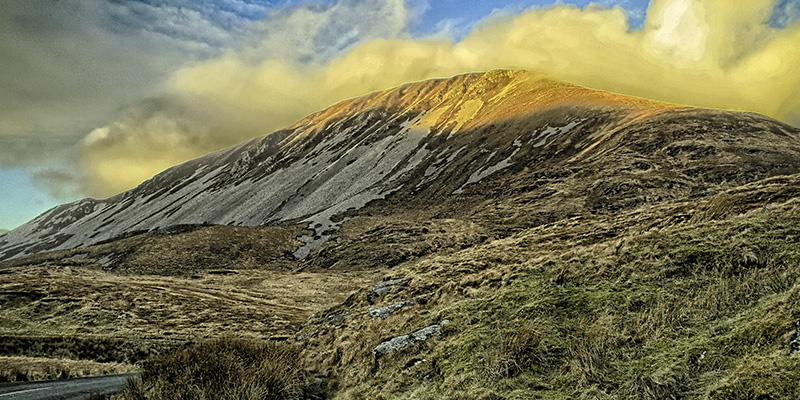
To understand the impact of the Donegal landscape on fabric design, one must first grasp the nature of the land itself. Donegal is known for its wildness—a patchwork of stone-walled fields, peat bogs, windswept peninsulas, and cloud-capped mountains. The light in Donegal is famously changeable, casting the land in constantly shifting hues of green, brown, grey, and gold. The skies are often moody, the sea turbulent, and the air filled with the smell of salt and turf smoke. This unique combination of geography and atmosphere has inspired generations of craftspeople to create textiles that reflect the place in both colour and form.
Donegal’s remoteness also contributed to the preservation of traditional skills. Isolated from the urban centres of Ireland and the wider forces of industrial homogenisation, Donegal retained a strong culture of handcraft well into the 20th century. This isolation fostered a kind of cultural resilience—one that celebrated the practical and artistic expression of the local environment through fabric.
Donegal Tweed: Cloth of the Land
Perhaps the most iconic product of Donegal’s textile heritage is Donegal tweed. While “tweed” itself is a general term for rough, woven woollen fabric, Donegal tweed is a distinctive subset that draws directly from the landscape for its character and colour.
Colour and Texture
Unlike the rigid tartan patterns of Scottish tweed, Donegal tweed is famous for its irregularity. The weavers of Donegal traditionally took their colour cues from the natural surroundings: the olive of moss, the purple of heather, the slate grey of the mountains, the rust of bracken, the blue of distant hills, and the earthy browns of peat. Tiny flecks of brighter colour—yellow like wild gorse, red like rowan berries—are worked into the yarn to mimic the speckled texture of the countryside.
These colours are often blended in yarns before weaving, producing a richly heathered fabric with a visual complexity that mirrors the varied topography of the region. The result is cloth that feels alive, as if it has absorbed and preserved the light and movement of the hills.
Weaving Culture and the Cottage Industry
Historically, Donegal tweed was produced in a domestic setting. Local farmers raised sheep and sheared them for wool, which was spun and dyed at home using natural dyes—lichen, fuchsia, and blackberry among them. Men typically worked the looms while women prepared the wool. This tradition of “cottage industry” ensured a deeply personal connection between the maker, the material, and the environment.
Even today, with the advent of more modern production techniques, much of Donegal tweed is still woven by skilled artisans who maintain this tradition. The fabric is not only functional—wind-resistant, warm, and durable—but it also carries with it the aesthetic fingerprint of the local geography.
Tweed to the World
Thanks to companies like Murphy of Ireland, Donegal tweed has achieved international acclaim. Our sales and exports continue to employ local weavers and often draw explicitly on the Donegal landscape for their seasonal collections. Designers might travel to Glenveagh National Park or the Derryveagh Mountains to find inspiration for new colour palettes or patterns, ensuring the land continues to be woven into the cloth—both literally and metaphorically.
Knitwear: Warmth from the Wild
While tweed is the most famous export, Donegal knitwear is another enduring tradition shaped by the landscape. The climate of Donegal – cold, wet, and windy – demands practical garments. Knitwear, often made from wool sourced locally or within Ireland, has long provided insulation and protection from the elements.
Patterns and Practicality
Though the Aran sweater is more commonly associated with the islands off Galway, Donegal has its own strong knitting tradition. Fishermen’s sweaters from this region typically featured simple but effective stitches, including ribbing, garter, and cables. These were not purely decorative—certain stitches offered added thickness and warmth, and the tightness of the knit helped retain body heat.
The neutral, earthy tones favoured in Donegal knitwear—oatmeal, peat brown, slate grey, and cream—echo the hues of the environment, just as tweed does. The texture of the wool, often coarse and weighty, is ideally suited to the rugged climate.
Homespun Innovation
Just like tweed, knitting in Donegal was historically a domestic task, especially during long winters. Local women would knit hats, scarves, gloves, and sweaters not only for their families but for sale at markets. In the 20th century, cooperatives and small knitwear businesses emerged, helping Donegal’s knitwear find a broader market while maintaining its rustic appeal.
Today, Murphy of Ireland, based in Ballybofey, County Donegal, blend traditional wool with both classic and modern designs and colour schemes. The inspiration, however, remains deeply local — designers often cite the cliffs of Slieve League, the shifting light on the ocean, or the shadows of Errigal mountain as influences.
Linen: Lightness from the Land
Though less commonly associated with Donegal than tweed or wool, linen has a historical presence in the region and across Ulster more broadly. Linen production in Ireland was centred in the north, and Donegal played its part in the cottage flax industry that thrived in the 18th and 19th centuries.
From Field to Fabric
Linen is made from the flax plant, which grows well in Ireland’s cool, damp climate. The rolling fields of Donegal provided a suitable environment for flax cultivation. Though industrial-scale linen production was more dominant in counties like Antrim and Down, Donegal’s small-scale farmers and weavers contributed to a robust domestic industry.
After harvesting, flax would be retted (soaked), dried, beaten, and spun into thread—all labor-intensive processes. Linen thread was then woven into fabric, valued for its breathability and strength.
Linen and Identity
Donegal linen, like other textiles from the region, was marked by its simplicity and connection to the land. The pale, natural colour of linen reflected the rawness of the material and the purity of its process. Used for shirts, nightshirts, and even ecclesiastical garments, Donegal linen added refinement to an otherwise rustic fabric tradition.
Today, linen from Donegal is enjoying a quiet revival. Artisan workshops and ethical fashion labels are rediscovering the value of locally sourced, sustainable materials, and linen – lightweight, biodegradable, and durable—is ideal for modern, environmentally conscious consumers.
Enduring Connection: Landscape and Identity
The true significance of Donegal’s textile tradition lies in its ability to reflect a sense of place. These fabrics are not just utilitarian; they are expressions of Donegal’s landscape, weather, culture, and people. The act of weaving, knitting, or spinning in Donegal is an act of storytelling—one in which every thread contains the memory of the land.
This connection between land and cloth also carries emotional weight. To wear a Donegal tweed coat or a locally knitted woollen hat is to wear a piece of the place. It evokes not only warmth and protection, but a sense of rootedness and continuity with generations past. For the diaspora, these garments carry even greater significance, serving as symbols of heritage and identity across oceans and time.
Contemporary Relevance and Sustainability
As the global fashion industry reckons with issues of overproduction and environmental impact, Donegal’s textile traditions offer an alternative path—one grounded in locality, quality, and sustainability.
Local companies increasingly emphasise traceability and ecological responsibility. Wool and flax are renewable resources, and traditional production methods use minimal synthetic inputs. Supporting Donegal fabrics means supporting small communities, preserving endangered skills, and choosing slow fashion over mass production.
Textile schools, artisan collectives, and government-supported initiatives continue to encourage younger generations to engage with traditional crafts. This ensures that the cultural and environmental relationship between the Donegal landscape and its fabrics will remain vibrant into the future.
Murphy of Ireland – Murphy of Donegal!
The relationship between the Donegal landscape and our fabrics is one of deep mutual influence. The land, in all its rugged glory, provides both the raw materials and the inspiration for textiles that are uniquely suited to life on its shores. In return, the fabrics of Donegal Tweed, Aran Knitwear, and Linen offer a way to read the land, to feel its textures, to carry its colours. They are not merely garments; they are woven landscapes, tactile memories, and testaments to human creativity shaped by nature.
In a world increasingly dominated by synthetic and disposable fashion, Murphy of Ireland’s textile traditions stand as a reminder that true style begins in the land itself – and endures through the hands that honour it.